
Positive Behavior Support
Positive Behavior Support (PSB) and the Policy
The principles outlined in the Policy are aligned with the contemporary application of PBS. Positive behavior support is an evidence-based framework consisting of four main elements:
1. Developing an understanding of why challenging behaviors occur by assessing the impact of the social environment, physical environment, and broader context on the person with a disability.
2. Involving stakeholders and capturing their perspectives.
3. Using the emerging understanding from assessment to implement and evaluate a person-centered sustainable support system around the person with a disability.
4. Focusing on enhancing the quality of life outcomes for the person with a disability and those around them.
Under the Policy, regulated restrictive practices are used in the context of safeguarding a person with a disability and/or those around them due to that person engaging in challenging behavior. Challenging behavior is understood to be a symptom of unmet needs. A person may show these behaviors when their key needs are not met.
The functional impact of disability often means that people with disabilities rely heavily on the people around them to understand what they need and support those needs to be met. In the case of complex disability and/or complex circumstances around a person’s life, it can be difficult for key stakeholders to recognize and meet the important needs of the person with a disability.
The intent of the Policy is to support the reduction and elimination of the use of restrictive practices for people with disabilities in WA. The following section describes important elements of PBS that can assist NDIS Behavior Support Practitioners and Implementing Providers in the process of supporting people with a view to finding alternatives to restrictive practice.

PBS and Behavior Support Plans
Under the NDIS Commission Positive Behavior Support Capability Framework (2019) and the Policy, NDIS Behavior Support Practitioners are required to practice consistently with the guiding principles of PBS in the provision of behavior support services. Under the Policy, NDIS Behavior Support Practitioners are required to develop a behavior support plan (BSP), which captures information about a person and how to support their needs, and also provides details of the proposed restrictive practices to support the Quality Assurance Panel process.
Following is an overview of some key elements of PBS-informed behavior support planning that are important for practitioners to hold in mind in the delivery of behavior support interventions, including in the development of a BSP for authorization of restrictive practice under the Policy.
Focusing on unmet needs and not just behavior
NDIS Behavior Support Practitioners are often engaged to develop BSPs in the context of often challenging and sometimes confronting behaviors, which may be impacting significantly on the person with a disability and/or those who love them and interact with them.
The natural tendency when faced with behavior is to turn the focus to the behavior. PBS recognizes that behavior happens in a broader environment and is often a sign that much more is going on for the person than just the behavior that can be seen. In this way, behavior is often referred to as just the “tip of the iceberg”.
Using a PBS lens, we turn our attention to the multiple factors that can influence what a person may experience.
The diagram on page 3 (Figure 1) highlights some of the factors that can influence what a person needs and experiences. Contemporary approaches to PBS recognize that unmet needs can significantly impact our ability to feel calm, regulated, and connected to others. When this occurs, challenging behavior may result as an expression of those unmet needs.
Figure 1: Factors that influence needs and behavior
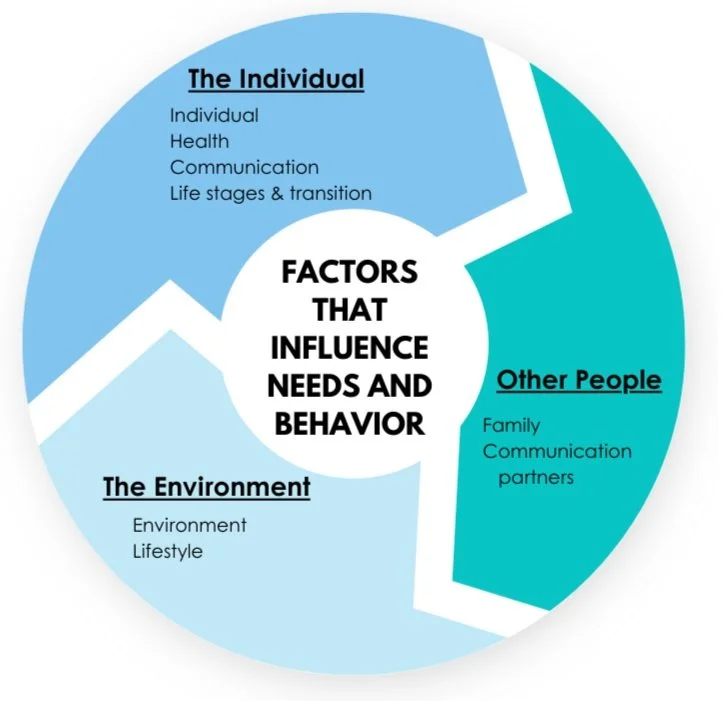
Factors that influence what a person experiences
It is recognized that there are some core, or foundational, needs that we all have, including the following:
The need for predictability, choice and control.
The need to be able to process and make sense of information.
The need to communicate with others.
Social interaction and sense of belonging needs.
Sensory regulation needs.
The need to experience pleasurable meaningful engagement and to have a sense of purpose.
It can be helpful to visualize these needs as the foundation upon which a house is built, where the house represents living our best life.
Supporting a good life requires careful attention to understanding and meeting foundational needs that we all have
It is therefore very important that NDIS Behavior Support Practitioners consider a range of individual needs, regulation needs, and needs related to the functional impact of the disability as well as environmental factors that are very likely influencing the behavior that can be seen, and ensure these are described within the BSP. It is not adequate or appropriate to only explore and describe the behavior that is observed when developing a BSP.
Engaging with the person and key stakeholders
Exploration of unmet needs and the impact of the environment in meeting those needs requires working in partnership with key people or stakeholders in the life of the person. This may include close family members, support workers, as well as other professionals in the person’s life.
Some of the principles for NDIS Behavior Support Practitioners to hold in mind when engaging a person and the stakeholders around them when developing a BSP include:
A person-centered approach: holding the person at the center of the process.
Develop empathy for the person by engaging with those around them to better understand what the person may be experiencing and how their behavior is likely an indicator of distress and significant unmet needs.
Systematic collaboration and participation: the person, family, and support system are involved and contributing.
The NDIS Behavior Support Practitioner adopts a ‘non-expert’ approach: recognizing that the experts about the person are the person themselves and those closest to them and drawing on the expertise and knowledge of the people around the person, including family members. The practitioner adopts a facilitative approach when working with others.
Listen and validate the experience of people impacted by behavior.
Empower, encourage, and support system knowledge and change, as well as self-determination for the person and those who support them.
Use respectful, clear, and appropriate communication.
Adopt an inclusive, non-discriminatory approach and be sensitive to and considerate of other cultures and experiences.
Identify and work with people within the system who take on the role of champions or advocates for the needs and rights of the person as well as those who support them.
A strengths-based approach in relation to the person as well as those around them: aiming to identify and work from strengths supports recognition of what is working and also supports empowerment of others.

Exploration Mindset
In the process of engaging with the person and stakeholders, it is also important that the NDIS Behaviour Support Practitioner adopts what can be viewed as an exploration mindset. An exploration mindset refers to the practitioner being neutral and willing to accommodate a range of views and information, and not jumping too quickly to making assumptions or adopting a common narrative or view as to why the behaviour is occurring.
To be neutral, the practitioner must be curious and willing to explore different perspectives and accommodate and consider potentially conflicting information. It is important that the NDIS Behaviour Support Practitioner develops hypotheses or potential explanations for what factors may be influencing or driving behaviour.
This ensures that curiosity is intentional, not aimless, and guided by clues about unmet needs for the person and/or the system around them that emerge through the process of engaging with others. It is important that the NDIS Behaviour Support Practitioner remain flexible and tentative in the hypotheses they develop and be prepared to discard them if the emerging information no longer supports them.
The final element of an exploration mindset is to be solution-focused and explore exceptions to problems. Much can be learned by exploring what happens when challenging behaviours are not present and by being curious about what needs may be met for a person when the challenging behaviour does not occur. Indeed, this is often a very powerful way of drawing on the strengths of the person and the system to better match supports to needs, with a result of less presence of challenging behaviour and better quality of life outcomes for all involved.
Functional Behavior Assessment
Functional Behavior Assessment (FBA) through a PBS lens can best be understood as the process of establishing an understanding of the needs of the person and the system around them in partnership or collaboration with the key people involved. Therefore, the goal of FBA is to collaboratively develop a shared understanding of the needs of the person with the system/stakeholders around them. This shared understanding of needs facilitates the development of supports which can result in:
Improved quality of life for the person and those around them
reduced challenging behavior and the resultant reduction in or elimination of the use of restrictive practices.
PBS and Quality Assurance Panels

Quality Assurance Panels play an important safeguarding and quality assurance role under the Policy.
It is important that the decision-making Panel members have a working understanding of PBS in order to provide a considered critique as to whether the requirements outlined in the Policy and ‘Procedure guidelines for the authorization of restrictive practices in NDIS funded disability services – Stage two’ (Procedure Guidelines) have been sufficiently addressed as documented in the BSP. The independent external NDIS Behavior Support Practitioner is expected to have an applied understanding of the application of PBS in clinical practice.
Specific considerations in addressing each of the principles as outlined in section 4.1.2. of the Procedure Guidelines (BSP is evidence-based) are detailed in the ‘Principles guiding the use of regulated restrictive practices’ information sheet (listed on the restrictive practices resources page under ‘Providers and Behaviour Support Practitioners’).
Also, see the Quality Assurance Panel information sheets listed on the restrictive practices resources page for more information about the Quality Assurance Panel process and the roles of decision-making Panel members.
PBS and requirements for justification of restrictive practice(s)
The Policy notes that Implementing Providers need to have explored and applied alternative evidence-based person-centered and proactive strategies to address challenging behaviors before resorting to the use of restrictive practices.
In the context of a PBS framework, a range of evidence-based and person-centered approaches can be accommodated.
The function of the behavior as a means of communicating a need or unmet needs within environment(s) should be considered and documented within the BSP. In addition, supports to meet those needs should be identified, even if those supports are under development.
Proactive strategies refer to both environmental and skill supports being designed and implemented to assist the person and the people around them to support their needs.
It is important that information is available to demonstrate that supports have been considered and/or are under development as part of satisfying the Quality Assurance Panel that the restrictive practice(s) is the least restrictive and most appropriate means of supporting a person safely at that point in time.

NexGenCounselling
PBS Services
At NexGenCounselling, we believe everyone deserves support to access opportunities that can be made available to them. You can expect a person-centered approach from our dedicated team of specialists. We offer functional support in Queensland.
NexGenCounselling Neurofunctional Services provides mental health assessment under NDIS Improved Daily Living Funding.
General intelligence enquiry
Intellectual disability
Learning disorders
Neurodevelopmental difficulties (such as ADHD)
Social and behavioral disorders and concerns
Psychometric assessments are also available for emotional functioning and may also be appropriate in determining the impact of clinical disorders (such as anxiety or depression) on daily functioning, and intellectual or learning capacity.
NexGenCounselling offers soultions for:
Anger
Concentration and Attention Difficulties
Parenting Difficulties
Self-injury
Trauma
Depression
Anxiety
Bullying
Emotional Regulation
Stress
Grief and Loss
Social Skills
Self Esteem